


Up to 90% less evaporation and up to 70% less heat loss: the thermal cover is an eco-friendly way to extend your swimming season.
Our thermal covers are laminated in France with enhanced polyethylene bubble film for optimum insulation and buoyancy. Available in several finishes, they take just seconds to handle with our manual rollers.
Up to 90% water saved thanks to the airtight bubble barrier that blocks natural evaporation.
Up to 6°C retained thanks to anti-UV translucent bubbles that trap accumulated heat.
Full range from 400 to 500µ for maximum long-term durability
Reinforced edges and stainless steel eyelets for easy handling, compatible with all rollers.
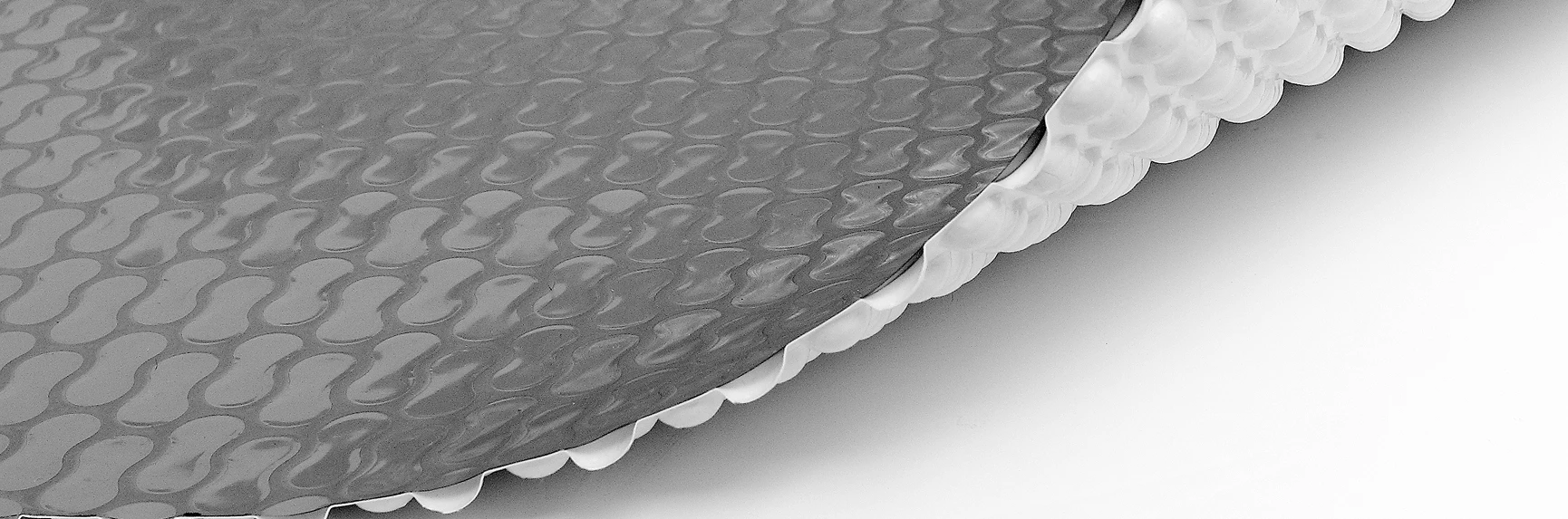
A unique bubble shape for greater cover strength and smart pool protection
Technology that combines heating performance and aesthetics
The cover that combines dark pigment heat absorption and translucent solar transmission for clean water and an elegant pool
The Blue/Black colour ensures an opaque cover, limiting photosynthesis for clearer water
Discover how bubble shape affects your thermal cover’s performance
A well-fitted cover retains heat better and keeps debris out of the pool
Covering your pool each evening drastically cuts water, energy and chemical use. Our thermal covers keep daytime heat in and block evaporation so your water stays at temperature.
All our thermal covers are made in France. Our skilled teams cut and finish each cover for a perfect fit on your pool.
Find answers to the most common questions about our thermal cover range (installation, maintenance, use…).
If you cannot find your answer, contact us!
It is a lightweight cover made of air bubbles that create a thermal barrier to limit heat loss and evaporation. In summer it sits directly on the water surface.
No—they are not considered safety devices because they do not meet standard NF P 90-308. They do not prevent falls into the pool.
During the day it captures solar energy and stores it, helping warm the pool. Depending on thickness, bubble shape and colour, it can raise water temperature by an average of 3 to 7°C.